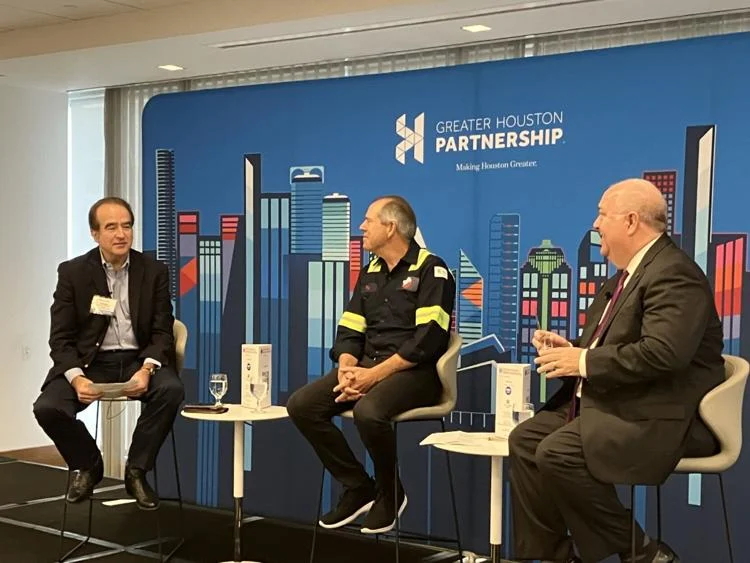
The international trade scene has been upended by President Donald J. Trump’s recent series of tariffs, but the greater Houston region’s trade economy is well-positioned to ride the wave of uncertainty, a group of business leaders said at a Greater Houston Partnership event last week.
The event at the GHP’s offices in downtown Houston marked the release of the regional chamber of commerce’s “Global ’25 Houston,” its annual compilation of data and insights about the regional trade picture.
Speakers at the event before a roomful of business executives admitted that Trump’s trade war, which he launched in early April with a White House event he called “Liberation Day,” has been met with the roiling of the economic waters, including plunges in the bond and stock markets and reciprocal tariffs from some of the country’s largest trading partners and discussions about a possible recession.
But Steve Kean, CEO of the GHP, said that as with many economic downturns, the metropolitan region is well-positioned to weather the storm.
“We are last in and last out when there’s disruption,” Kean said in his opening remarks.
Turning to the data from the report, Kean said the Houston region grew by nearly 200,000 residents in 2024, the largest population increase in the region’s history.
“We’re still adding jobs, we added net new jobs in March. Not as much historically for the month of March, but we’re still adding net new jobs,” he said.
Commenting on the prospects of international investment in the region, Kean said, “some longer-term investment decisions have been paused, no question about it, but not all of them. We’re still growing in investment.”
Kean said a representative of the U.S. Chamber of Commerce he talked to told him that many of its small business members have said that they are going out of business due to the uncertainty caused by the trade war. But Kean said that so far the GHP has not heard that from any of its own members, and a smaller chamber of commerce in the region also indicated that its small-business members are not preparing to close up shop any time soon.
“The key is that this is an uncertain time. Will the uncertainty last? For a short period, it will be more extended. Will this really be a 90-day thing or will it be more extensive? That will, obviously, increase the disruption,” he said.
Still, he said, the Houston region because of its location on the Gulf Coast and its large manufacturing base remains an attractive destination for the kind of onshoring of manufacturing that Trump has said is one the primary goals of his tariffs regime.
“We are an attractive destination for onshoring operations and investment, and we’re taking full advantage of that as a community. This is not theoretical. We have tangible announcements of this onshoring activity,” he said.
“I think we’re uniquely positioned to weather these changes. We will likely be less affected and recover more quickly,” he said.
In a panel discussion that followed, moderator George Gonzalez, a partner with the Haynes and Boone law firm, spoke with Ric Campo, president and CEO of the Camden real estate company and chairman of the Port of Houston Authority Commission and Jeff Simmons, senior vice president of the Toshiba Americas Group.
“My view is there are two overarching policy goals of the Administration that I think are very positive for Houston,” Gonzalez said. “Number one, unleashing energy. If that becomes successful, it’s going to be a humungous benefit for Houston. And then number two, is onshoring, bringing manufacturing into the United States. Because of our location, we are competitively positioned for becoming even more a manufacturing powerhouse for the United States.”
Simmons of the Japan-based manufacturing giant Toshiba, whose U.S. operations have been based in Houston for a half-century, said that the trade war has prompted the company to continue to make adjustments to his supply chains that began during the COVID-19 pandemic.
“Because of some of the changes in the Administration, we are focused on adapting our manufacturing supply chains. We’re having to rethink a lot of our sourcing relationships,” Simmons said. “And I think a lot of companies are doing the same thing. So we’re scrambling a bit to try and find ways to onshore some of our supply chain. COVID was a big wake-up for us. The Asian supply chain has not recovered yet from COVID yet, and we’re now three years later.”
Campo voiced a somewhat sanguine tone toward how disruptions from the trade war might impact the Port of Houston, the biggest in terms of total tonnage in the country.
“What’s going on is the rules are changing, and that’s caused uncertainty. At the end of the day, the rules will be figured out, and then we’ll play by the rules,” Campo said.
“There are three things we do really well. We’re low cost providers. We have incredible productivity. And three, we have lower risk to moving things in and out of the region,” he said.
According to the GHP’s latest global trade report, the Houston region’s top three international trading partners are The Netherlands (driven by oil exports amid EU energy diversification), China (a key supplier of industrial equipment and electronics), and Mexico (Texas’s most integrated supply chain partner).
The other countries in the top ten are South Korea, Germany, Brazil, the United Kingdom, Japan, India, and Canada.