Every February, Black History Month invites the nation to reflect — not only on the struggles of the past, but on the builders of the future. We honor Harriet Tubman’s bravery, Dr. Martin Luther King Jr.’s moral clarity, Mae Jemison’s scientific brilliance, and countless others who reshaped the trajectory of America.
But history is not only behind us.
It is being written right now — in laboratories, research institutes, startups, and universities — by Black computer scientists and AI researchers who are defining how artificial intelligence will shape our world.
If the 20th century was defined by civil rights marches and moon landings, the 21st century will be defined by algorithms, machine learning systems, and artificial intelligence. And Black scientists are making sure that this next revolution is not only powerful — but just.
The New Civil Rights Frontier: Artificial Intelligence
Artificial intelligence already determines who gets loans, how medical diagnoses are made, how criminal risk is assessed, how job applicants are filtered, and even how faces are recognized by law enforcement.
That means AI is not neutral. It carries the values, data, and biases of those who build it.
Black AI researchers like Dr. Timnit Gebru and Dr. Joy Buolamwini have exposed something critical: when AI systems are trained on biased data, they can replicate and amplify inequality. Facial recognition systems have misidentified darker-skinned women at disproportionately high rates. Automated hiring systems have shown bias. Predictive policing tools have reflected historical inequities.
Black History Month has always been about confronting injustice and expanding democracy. Today, that work continues in the realm of code.
Dr. Timnit Gebru: Demanding Accountability in AI
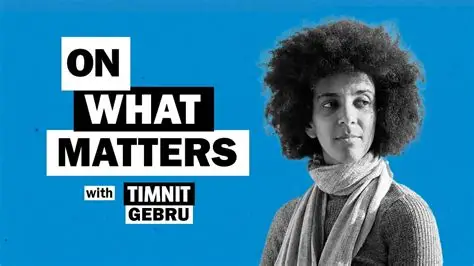
Dr. Timnit Gebru, co-founder of Black in AI and founder of the Distributed Artificial Intelligence Research Institute (DAIR), has become one of the most influential voices in ethical AI. Her research revealed troubling flaws in large AI models — including environmental costs, embedded biases, and risks to marginalized communities.
Like civil rights leaders before her, Gebru insisted that power must be examined, not blindly celebrated. She challenged major tech institutions to take responsibility for the social consequences of their tools.
Her work embodies a Black History Month principle: progress without justice is not progress at all.
Dr. Joy Buolamwini: The Algorithmic Justice League
Dr. Joy Buolamwini, founder of the Algorithmic Justice League, brought global attention to racial bias in facial recognition technology. Her groundbreaking “Gender Shades” study revealed that facial recognition systems were significantly less accurate at identifying darker-skinned women compared to lighter-skinned men.
Her work led to major corporations reconsidering and in some cases suspending facial recognition deployments.
That is modern civil rights advocacy — not in courtrooms or marches, but in peer-reviewed research and data transparency.
Buolamwini reframed technology as a civil rights issue. During Black History Month, we remember that freedom and fairness must evolve alongside innovation.
Rising Global Voices in AI
The next generation of Black AI scientists is not limited to the United States. It is global.
Abeba Birhane
An Ethiopian cognitive scientist and AI researcher, Birhane’s work examines how massive AI datasets are collected and how they often include harmful or exploitative content. She has exposed how scraping internet data without consent can embed harmful narratives into machine learning systems.
Her research challenges the idea that bigger data automatically means better intelligence.
Adji Bousso Dieng
A Senegalese machine learning researcher at Google Brain, Dieng’s work in probabilistic modeling and deep learning advances the mathematical foundations of AI. Her contributions demonstrate that Black excellence in AI is not limited to ethics — it includes high-level technical innovation shaping the next generation of machine learning systems.
Nina da Hora
An Afro-Brazilian computer scientist, Nina da Hora’s research intersects AI, cybersecurity, and algorithmic racism. She advocates for digital rights and equitable access to technological systems.
Her work reminds us that the digital divide is not just about internet access — it is about representation in design.
Why Black Representation in AI Matters
Technology shapes opportunity.
If AI determines hiring, credit, healthcare diagnostics, education personalization, or public safety, then representation among those designing these systems is not optional — it is essential.
Black History Month traditionally highlights “firsts” — the first Black astronaut, the first Black Supreme Court justice, the first Black mayor of a major city.
Today, we are witnessing the rise of Black AI architects — people shaping systems that will impact billions.
Representation in AI matters because:
- It reduces blind spots in design
- It challenges embedded historical bias
- It expands economic opportunity
- It fosters inclusive innovation
- It builds systems that reflect diverse human realities
AI will likely influence more decisions in the next 20 years than any previous technological system in history. The presence of Black scientists in that space ensures that future technologies reflect the full spectrum of humanity.
From Civil Rights to Digital Rights
The civil rights movement fought for voting access, housing equality, and desegregation.
The next frontier may involve algorithmic fairness, data rights, privacy protections, and equitable AI governance.
When predictive systems are used in courtrooms or law enforcement, when healthcare AI systems assist diagnoses, when automated decision-making influences mortgage approvals — the stakes are no less significant than past civil rights battles.
Black AI researchers are carrying forward the legacy of advocacy — this time in code reviews, research papers, and congressional testimony.
They are not simply technologists.
They are architects of ethical systems.
How This Could Change the World
Artificial intelligence is poised to reshape:
- Healthcare diagnostics
- Climate modeling
- Transportation systems
- National security
- Education
- Workforce automation
- Financial markets
If AI is designed inclusively and ethically, it can:
- Improve medical outcomes in underserved communities
- Expand financial access
- Reduce discriminatory outcomes
- Improve disaster response
- Enhance educational equity
But if left unchecked, AI can entrench inequality at scale.
The difference lies in who is building it — and who is asking hard questions.
Black AI scientists are not just contributing to technology; they are shaping the moral framework around it.
Black History Month: A Celebration of Builders
Black History Month is not only about remembering struggle. It is about recognizing builders — scientists, educators, engineers, inventors, and visionaries who create new pathways.
In 1953, Dr. Jewel Prestage (a pioneering political scientist) became the first Black woman to earn a Ph.D. in political science. In 1983, Dr. Mae Jemison went to space. Today, Black AI scientists are navigating a different frontier — digital space.
They are ensuring that artificial intelligence, one of the most powerful forces of our time, develops with fairness, accountability, and humanity at its core.
History will remember this era.
The question is whether we will invest in it.
A Call to Invest in the Future
If we want AI systems that reflect justice, we must:
- Invest in STEM education for Black youth
- Fund research at HBCUs
- Support organizations like Black in AI
- Encourage mentorship pipelines
- Promote equitable hiring in tech
The future of AI should not be shaped by a narrow demographic.
It should be shaped by the full spectrum of talent.
During Black History Month, we honor those who broke barriers.
Today’s Black AI scientists are not just breaking barriers — they are rewriting the rules of how intelligence itself is built.
And that may be one of the most powerful chapters of Black history yet.