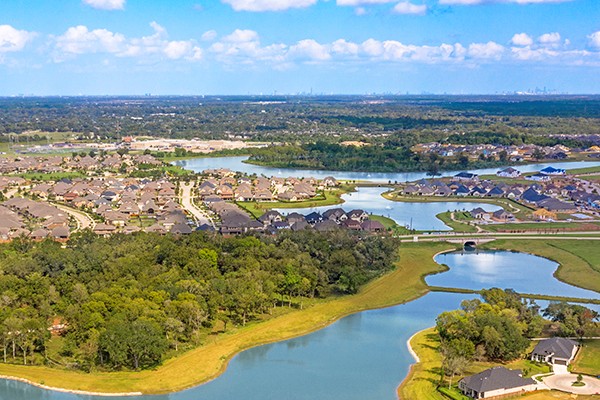
Southwest Fort Bend County sits at a pivotal moment. Long defined by rural land, historic towns, and agricultural roots, this part of the county now finds itself adjacent to some of the fastest-growing corridors in Texas. As growth pushes west and southwest from Houston, the central question is no longer whether development will come, but how it will be shaped. An improvement district offers a proven, locally controlled way to guide that growth in a positive, equitable, and fiscally responsible direction.
What an Improvement District Is—and Why It Matters
An improvement district (often structured as a regional improvement district, public improvement district, or similar authority under Texas law) is a public entity created to finance and manage infrastructure within a defined area. Unlike ad-hoc development, an improvement district plans infrastructure holistically—roads, drainage, water, wastewater, parks, public spaces, and utilities—before growth overwhelms existing systems.
For southwest Fort Bend County, this matters because the area has historically been under-served by infrastructure while sitting near high-growth zones. An improvement district allows landowners, residents, and local governments to proactively plan rather than react.
Infrastructure First, Not Last
One of the greatest strengths of an improvement district is its “infrastructure-first” approach. Instead of waiting for piecemeal development to strain roads or flood systems, the district can finance and build infrastructure up front using long-term revenue bonds repaid over time by new development.
In southwest Fort Bend County—where flooding resilience, road connectivity, and utility capacity are ongoing concerns—this approach reduces long-term public costs. Well-designed drainage systems, coordinated road networks, and modern utilities protect existing residents while making future development safer and more sustainable.
Protecting Taxpayers While Attracting Investment
A common concern about growth is the burden it can place on existing taxpayers. Improvement districts address this by shifting much of the infrastructure cost to the development that benefits from it. New growth helps pay for new infrastructure, rather than relying on countywide tax increases.
At the same time, the certainty created by an improvement district attracts higher-quality investment. Developers, employers, and institutional partners are more likely to invest when infrastructure plans, timelines, and governance are clear. That predictability translates into better projects, stronger job creation, and a broader tax base for Fort Bend County as a whole.
Preserving Community Character and History
Southwest Fort Bend County includes historic communities such as Kendleton, one of Texas’s earliest freedmen’s towns. An improvement district does not have to mean erasing history. In fact, it can be a tool to protect it.
With coordinated planning authority, an improvement district can incorporate historic preservation, cultural tourism, parks, and public art into its development framework. Rather than uncoordinated sprawl, growth can reinforce local identity—supporting heritage projects, small businesses, and community gathering spaces that reflect the area’s history.
Jobs, Housing, and Opportunity
Improvement districts are engines of opportunity. Infrastructure unlocks land for housing, light industrial, logistics, renewable energy, and community-serving commercial uses. For southwest Fort Bend County, this means the potential for local jobs closer to home, a wider range of housing options, and pathways for residents to participate in economic growth.
Importantly, districts can be structured to encourage mixed-income housing and workforce development, ensuring that growth benefits long-time residents as well as newcomers.
Local Control and Accountability
Unlike distant or purely private development decisions, an improvement district is governed locally and operates under public law. Its actions are transparent, its finances are audited, and its mission is defined by statute and local agreements. This structure provides safeguards while allowing flexibility—an essential balance in a diverse county.
Local oversight ensures that infrastructure priorities align with community needs, whether that means flood mitigation, safe roads, broadband access, or public spaces.
A Strategic Tool for a Growing County
Fort Bend County’s growth will continue. The choice facing southwest Fort Bend is whether to let that growth arrive in fragments—or to guide it with intention. An improvement district offers a strategic framework to do the latter: coordinating infrastructure, protecting taxpayers, honoring history, and creating opportunity.
Done correctly, an improvement district is not about rapid or reckless development. It is about disciplined planning, long-term thinking, and giving southwest Fort Bend County the tools to shape its own future.
As Fort Bend looks ahead, an improvement district could be the mechanism that turns growth pressure into shared prosperity—ensuring that the southwest part of the county grows stronger, more resilient, and more connected, while remaining true to the communities that call it home.