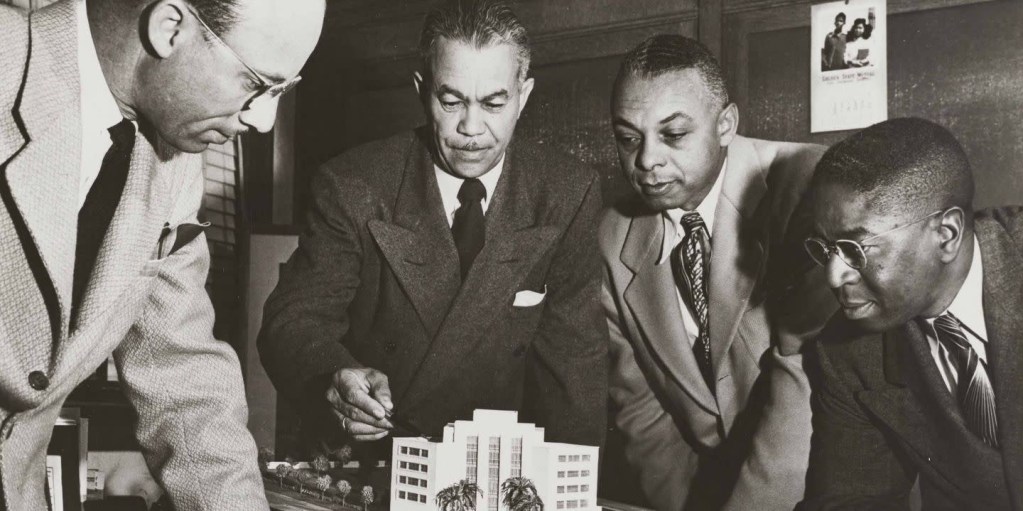
Throughout history, communities have always been shaped by those bold enough to build—builders who see possibility in empty land and opportunity in hard times.
African and African-American history is filled with these visionaries. They were architects, entrepreneurs, bankers, and developers who created economic centers that empowered entire communities.
From the great cities of West Africa to the economic corridors of Durham, North Carolina, and Washington, D.C., their work laid the foundations for generations of prosperity.
These stories remind us that economic power is often built block by block, storefront by storefront, and neighborhood by neighborhood.
Africa’s Early Builders of Cities and Learning
Long before modern development companies existed, African empires built thriving cities and trade networks.
One of the most famous rulers of that era was Mansa Musa, whose reign during the 14th century transformed the Mali Empire into one of the wealthiest civilizations in the world.
Mansa Musa invested heavily in urban development, financing mosques, universities, and public infrastructure. Cities such as Timbuktu became international centers of learning and commerce.
One of the architectural achievements from that era remains the Djinguereber Mosque, constructed in 1327 and still standing today.
The empire’s leaders demonstrated that investment in education, architecture, and trade could transform regions into powerful economic centers.
That same spirit of development would appear again centuries later in the United States.
Durham, North Carolina: America’s First Black Wall Street
At the turn of the twentieth century, one of the most extraordinary examples of Black economic development emerged in Durham, North Carolina.
Along Parrish Street, African-American entrepreneurs created what became known as Black Wall Street—a thriving financial and business district that served as a model for Black economic independence.
Durham’s Black business community was built by remarkable leaders such as John Merrick, Charles Clinton Spaulding, and Richard B. Fitzgerald.
Their businesses helped create one of the largest Black-owned economic ecosystems in the United States.
At the heart of this movement was the North Carolina Mutual Life Insurance Company, founded in 1898.
At one point, the company became the largest Black-owned business in the United States.
Durham’s Black Wall Street supported:
• banks
• insurance companies
• professional offices
• retail stores
• real estate development
The district demonstrated how entrepreneurship, property ownership, and community investment could generate long-term economic power.
For many African Americans during the Jim Crow era, Durham represented proof that financial independence and business success were possible despite systemic barriers.
Washington, D.C. and the Rise of “Black Broadway”
Another center of African-American economic development emerged in the nation’s capital.
During the early twentieth century, the U Street Corridor became one of the most important Black cultural and business districts in the United States.
Often called “Black Broadway,” the area was home to banks, theaters, restaurants, and professional offices owned by African Americans.
The corridor attracted artists, musicians, and entrepreneurs from across the country.
The legendary Howard Theatre became a major cultural venue, hosting performers such as Duke Ellington, Ella Fitzgerald, and Marvin Gaye.
But beyond entertainment, the neighborhood represented economic empowerment.
Black developers and business leaders built apartment buildings, commercial storefronts, and community institutions that provided opportunity in a segregated city.
Washington’s Black professional class—including lawyers, doctors, teachers, and government workers—helped create a thriving middle class that invested heavily in property ownership and community development.
For decades, U Street stood as one of the most powerful examples of African-American urban entrepreneurship in America.
The Legacy of Tulsa’s Black Wall Street
Another remarkable example of African-American development took place in Greenwood District, a thriving commercial center in Tulsa, Oklahoma.
Entrepreneurs such as O. W. Gurley purchased land and encouraged Black families and businesses to build homes and commercial property.
Within a few decades, Greenwood had become one of the wealthiest Black communities in the country.
The district included:
• hotels
• theaters
• grocery stores
• banks
• law offices
• luxury homes
Although the community suffered devastation during the Tulsa Race Massacre, its legacy continues to inspire discussions about entrepreneurship, wealth building, and community investment.
Modern Builders and Developers
Today, African-American developers continue to shape cities across the United States.
One of the most prominent modern figures is Don Peebles, founder of The Peebles Corporation.
Peebles has developed hotels, residential towers, and mixed-use projects in cities such as Washington, D.C., Miami, and New York.
Across the country, a growing number of African-American developers are revitalizing neighborhoods, building housing, and investing in new economic centers.
Their work reflects a long tradition of community-driven development that stretches back centuries.

Lessons for the Future
The history of African and African-American builders is ultimately a story about vision.
From the cities of West Africa to the business districts of Durham, Washington, and Tulsa, these communities demonstrated that economic independence grows from investment, education, and property ownership.
Their achievements created opportunities not only for individuals but for entire generations.
Today, as cities across America continue to grow—including fast-expanding regions like Fort Bend County—the lessons from these historic builders remain relevant.
Strong communities are built through entrepreneurship, ownership, and long-term investment.
And just as earlier generations built thriving neighborhoods against tremendous odds, future builders will continue shaping the cities of tomorrow.
The legacy of Black Wall Street—whether in Durham, Washington, or Tulsa—is not only a chapter in American history.
It is a blueprint for economic empowerment that continues to inspire builders around the world.
Why Fort Bend Is the Perfect Place for the Next Generation of Black Developers to Build America’s Future Cities
Across American history, Black builders, developers, and entrepreneurs have repeatedly transformed communities against extraordinary odds. From the thriving business districts of Durham, North Carolina to the economic influence of Washington, D.C., African American visionaries have created neighborhoods, institutions, and entire economic ecosystems that changed the trajectory of cities.
Today, a new frontier for that legacy may be emerging in an unexpected place: Fort Bend County, Texas.
Located just southwest of Houston, Fort Bend has quietly become one of the fastest-growing and most diverse counties in America. With rapid population expansion, strategic geography, and unprecedented infrastructure investment, it may offer the ideal canvas for a new generation of Black developers to build something historic — the next great American city.