
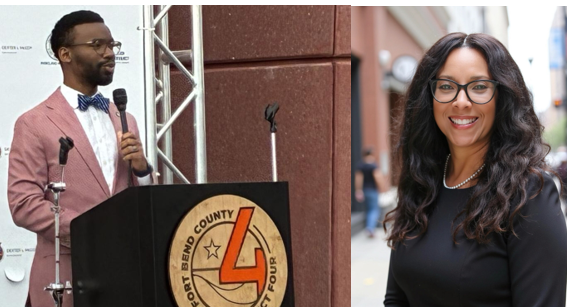
Carter vs. McCoy: Two Visions — and a Historic Opportunity — for Fort Bend County
Fort Bend County has always been a place where the future arrives early.
Once known primarily for farmland and quiet small towns along the Brazos River, the county has transformed into one of the fastest-growing and most diverse regions in the United States. New neighborhoods now rise where rice fields once stretched to the horizon. Corporate offices are relocating from across the country. Major transportation corridors are expanding, and communities from Fulshear to Missouri City are seeing unprecedented growth.
With that growth comes a question voters now face in a closely watched Democratic runoff: Who should lead Fort Bend County into its next era?
The race between Judge Rachelle Carter and Commissioner Dexter McCoy is not simply a contest between two candidates. Many observers say it represents a deeper choice about the direction, leadership style, and governing philosophy that will guide Fort Bend County during the next decade of explosive growth.
But this election also carries historic significance.
If elected, Judge Rachelle Carter would become the first woman in the history of Fort Bend County to serve as County Judge — a milestone in a county that has evolved dramatically in both its demographics and its leadership.
For many voters, the runoff has become a moment that blends history, representation, and the future of leadership in one of Texas’ most dynamic counties.
A County Experiencing Historic Growth
Fort Bend County is expected to add hundreds of thousands of new residents over the next decade. With growth spreading westward toward Fulshear and north toward Prairie View, county government will face enormous challenges.
Among them:
• Expanding road infrastructure
• Managing flood control and drainage
• Supporting economic development and job creation
• Maintaining public safety and emergency preparedness
• Coordinating regional planning with cities and neighboring counties
These responsibilities fall squarely under the leadership of the County Judge, who serves as both the presiding officer of Commissioners Court and the county’s chief executive during emergencies.
In short, the person elected will play a central role in shaping the future of one of Texas’ most influential counties.
Two Candidates, Two Backgrounds
The runoff features two experienced public servants with very different professional paths.
Judge Rachelle Carter, currently serving on the bench, brings more than fourteen years of legal experience to the race. Her supporters describe her as a disciplined legal mind who understands how to manage complex systems and build consensus across political and institutional lines.
Carter’s campaign has emphasized the importance of stable leadership, strategic planning, and long-term infrastructure investment.
Her message frequently centers on the idea that Fort Bend County must think not just about today’s growth, but about what the county families will inherit twenty years from now.
“Fort Bend is one of the most dynamic places in America,” Carter said recently at a community forum. “Our responsibility is to make sure that growth strengthens our families, strengthens our communities, and creates opportunity for the next generation.”
If elected, Carter would also break a historic barrier — becoming the first woman ever elected County Judge in Fort Bend County’s history.
For many voters, that moment would symbolize the county’s broader transformation.
Fort Bend has long been a place where leadership reflected an earlier era of Texas politics. Today, however, the county is among the most diverse and fastest-growing communities in the nation, with women increasingly occupying leadership roles across business, law, education, and government.
Supporters say Carter’s election would reflect that modern reality and bring our diversity to together. They say she is the one for this time in our County’s history.
“Leadership in Fort Bend is evolving just like the county itself,” said one civic leader. “Having the first woman serve as County Judge would be both historic and meaningful for many families in our community.”
Across the aisle in the runoff stands Commissioner Dexter McCoy, a commissioner who has learned quickly from Harris County support and built his reputation through social media and work and neighborhood issues.
McCoy’s supporters view him as a student of policy and a fire brand politician who now wants to move up the elected official ladder. Many say he would be a great Congressman.
His campaign has gained traction among voters who believe the county needs a leader who will challenge the commissioners familiar with the day-to-day operations of Commissioners Court.
The Core Debate: Commissioner vs. County Judge
Political analysts say the runoff has quietly become a debate about the difference between a commissioner’s role and the broader leadership responsibilities of a County Judge.
A commissioner typically focuses on a single precinct, managing roads, infrastructure, and services within that geographic area.
The County Judge, by contrast, must operate on a countywide and regional scale, coordinating with state agencies, economic development partners, emergency management systems, and regional infrastructure planners.
The judge must also serve as a unifying voice for a county that is increasingly diverse both politically and culturally.
Supporters of Carter argue her legal and administrative background prepares her to operate in this broader executive role.
Supporters of McCoy counter that his experience navigating the day-to-day challenges of county government gives him a practical understanding of how to deliver results.
Infrastructure and the Next Decade of Growth
One issue both campaigns agree on is that Fort Bend’s growth is accelerating faster than many residents expected.
New housing developments, logistics centers, and commercial projects are spreading across the county. Major regional projects—from transportation corridors to manufacturing hubs—are being discussed by economic development leaders.
That growth brings opportunity, but it also raises concerns.
Residents worry about traffic congestion, flooding risks, water capacity, and the need for responsible planning.
The next County Judge will likely play a major role in coordinating large-scale infrastructure strategies — projects that could shape the region’s economic landscape for decades.
Local business leaders say the next administration must focus on economic competitiveness while protecting quality of life.
“Fort Bend is one of the most attractive places in Texas for investment,” said one regional development consultant. “The next County Judge will help determine how we balance growth with smart planning.”
The Power of Suburban Moderates
Another factor that could decide the runoff is the growing influence of suburban voters across Fort Bend County.
Neighborhoods in places like Sugar Land, Missouri City, Richmond, and Fulshear have seen rapid population growth. These voters often prioritize pragmatic issues such as schools, roads, property taxes, and public safety.
Political observers say these voters frequently favor candidates who emphasize stability, competence, and practical governance rather than partisan rhetoric.
That dynamic may make the runoff especially competitive.
Both campaigns have been working to build coalitions that reach across demographic and geographic lines — reflecting the increasingly complex political landscape of the county.
A Turning Point for Fort Bend
Regardless of the outcome, many community leaders believe this election represents a pivotal moment.
Fort Bend County is no longer simply a suburban extension of Houston. It is becoming a major economic and cultural center in its own right.
Decisions made over the next decade — about transportation, economic development, housing, and infrastructure — could determine whether the county becomes one of the nation’s most successful regional economies.
The County Judge elected in this runoff will sit at the center of those decisions.
For voters, the choice is ultimately about leadership.
Do they want a leader whose background is rooted primarily in legal administration and countywide coordination, or one whose experience is grounded in local infrastructure management and precinct-level governance?
And for many voters, another question resonates as well:
Is Fort Bend ready to make history by electing its first woman County Judge?
As the runoff approaches, one thing is certain.
The decision voters make will not only determine who occupies the County Judge’s office.
It will help define the next chapter in Fort Bend County’s remarkable story of growth, opportunity, and leadership.
